I’ve always been fascinated by space. As a kid, I used to stare at the night sky and wonder how humans could ever figure out what’s really out there. Fast forward to today, and artificial intelligence is doing in a few seconds what used to take scientists weeks or even years. Space exploration has always been about pushing limits, but now AI is accelerating that push like never before.
I’ve been digging into the latest research and tools, and it’s safe to say that AI in space exploration isn’t just some sci-fi fantasy; it’s happening right now, in 2025, and it’s making things faster, safer, and more efficient than we ever thought possible.
What AI Does in Space Exploration
Let me give you a few concrete examples, because that’s where the story gets interesting:
Data Crunching in Seconds
Space telescopes and satellites send down terabytes of data daily. In the past, teams of scientists would spend years combing through this info. Now, AI can sift through astronomical datasets in minutes, spotting patterns and anomalies like exoplanets, black holes, or even signs of habitability. NASA’s Kepler mission data, for example, was re-analyzed using AI, and it discovered exoplanets scientists had originally missed.
Autonomous Navigation for Rovers and Spacecraft
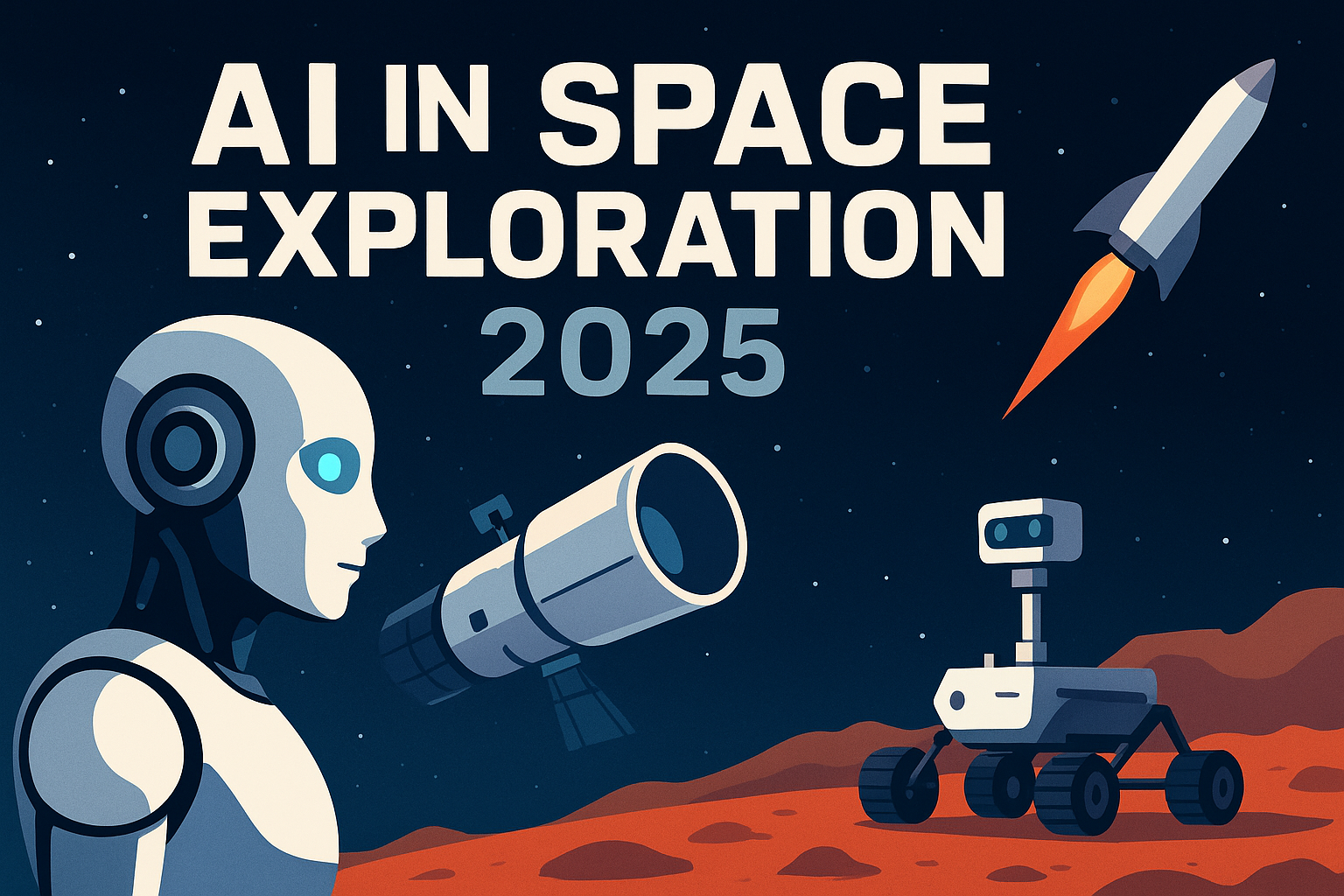
In the old days, if a rover on Mars needed to turn left or right, it had to “phone home” to Earth and wait for instructions. That’s a huge delay when signals can take up to 20 minutes to travel one way. Today, AI lets rovers like Perseverance decide on their own how to avoid obstacles, making them independent explorers instead of remote-controlled cars.
Predictive Maintenance for Spacecraft
I think of AI like a mechanic in space. Spacecraft are filled with moving parts that can fail, and in the past, we only reacted after something went wrong. AI now predicts potential failures before they happen, flagging issues so astronauts and engineers can fix them early. That’s a lifesaver literally.
Space Weather Forecasting
Solar flares and radiation bursts are a nightmare for astronauts and satellites. AI models now give near-instant forecasts of space weather, reducing risks for missions. Compare that with decades ago, when we were flying nearly blind and just hoping the Sun behaved itself.
Safety and Efficiency: Better Than Before
Here’s the thing: space is not forgiving. Mistakes are expensive, and sometimes fatal. But AI is making space missions safer and leaner than ever.
- Safety: AI monitoring systems detect hazardous conditions faster than humans, like unexpected orbital debris heading for a spacecraft. With real-time decision-making, the chance of missing something dangerous is lower than it’s ever been.
- Efficiency: Missions that used to require giant teams can now be run with fewer people. AI handles routine tasks, trajectory adjustments, data cleaning, and communication scheduling so scientists can focus on actual discoveries.
When you think about the old Apollo missions, with thousands of people monitoring every dial and switch, and compare it to how AI runs simulations today, the difference is night and day. It’s like comparing driving with a paper road map to using Google Maps with live traffic.
How People Like You and Me Can Experiment with Space AI
This is where it gets fun. You don’t have to be sitting in NASA’s control center to try some of this stuff yourself. If you’re a curious mind (like me), here’s how you can dabble:
- NASA’s Open Data Portal
NASA publishes enormous datasets, from Mars rover photos to exoplanet catalogs. You can use AI tools like TensorFlow or PyTorch to analyze these datasets at home. People have actually discovered things using open data, yes, real amateurs contributing to science. - Google AI and Exoplanet Hunting
Google released AI models that helped identify planets outside our solar system. You can explore similar datasets and train your own AI to recognize exoplanets. - SpaceHack.org
A hub for citizen science projects where you can join AI-powered space exploration challenges. It’s a great place if you want to test your skills on actual space problems without needing millions of dollars in funding. - AI-Powered Simulations
Platforms like Universe Sandbox now integrate AI features that let you simulate orbital paths, collisions, and even star formations. It’s part science, part video game, and all addictive.
Pros and Cons of AI in Space Exploration
Like any shiny new technology, AI has its strengths and drawbacks. From my research and testing, here’s the balance sheet:
Pros:
- Analyzes massive data at lightning speed
- Reduces reliance on constant human input
- Makes spacecraft and rovers more autonomous
- Predicts problems before they happen
- Cuts costs by reducing manpower
Cons:
- Heavy reliance on algorithms means errors can snowball if the AI is wrong.
- AI systems are only as good as the data they’re trained on (garbage in, garbage out)
- Hackers could potentially target space AI systems (a new kind of cosmic cybersecurity threat)
- Some scientists worry we may trust AI too much, sidelining human intuition.
What’s Next in 2025 and Beyond
Here’s what really excites me: AI isn’t just helping us look at planets, it’s helping us get ready to live on them. From managing life support systems on Mars habitats to running hydroponic farms in space, AI will be the silent partner, making it possible.
There’s talk of AI running entire outposts on the Moon before humans even arrive, setting up power grids and testing soil conditions. It sounds like science fiction, but that’s the direction things are heading.
And if AI can handle all the boring but essential tasks, astronauts can focus on exploration, science, and maybe even enjoying the view instead of worrying about whether the oxygen filter is clogged.
Final Thoughts
AI in space exploration isn’t just about sending robots to Mars; it’s about extending human presence beyond Earth, safely and effectively. From autonomous rovers to predictive maintenance, it’s giving us speed and reliability we never had before.
When I think back to the Apollo missions, where even a simple calculation required armies of mathematicians, and compare it to today, where an AI algorithm can do it in a blink, it’s clear: AI is the co-pilot we always needed.
And here’s the kicker, you don’t need a NASA badge to join in. With open data, free AI tools, and online projects, you can be part of this new chapter in exploration.
So the next time you look up at the stars, remember: the future of space isn’t just rockets and astronauts, it’s algorithms, neural networks, and maybe you, too.